Amberley Primary School
History
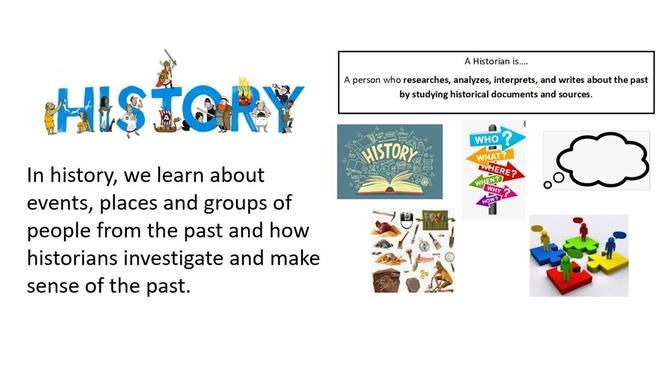
History is who we are and why we are the way we are.
Curriculum Intent
The study of history can bring pupils into a rich dialogue with the past and with the traditions of historical enquiry. The past and changing accounts of the past have shaped the identities of diverse people, groups and nations. Through history, pupils come to understand their place in the world, and in the long story of human development. The study of history challenges pupils to make sense of the striking similarities and vast differences in human experiences across time and place. At Amberley, we want to:
- Incorporate our 3 core values into our teaching of history. We learn about events, time periods and people from the past who have shown nurturing, innovation or aspiration in their achievements.
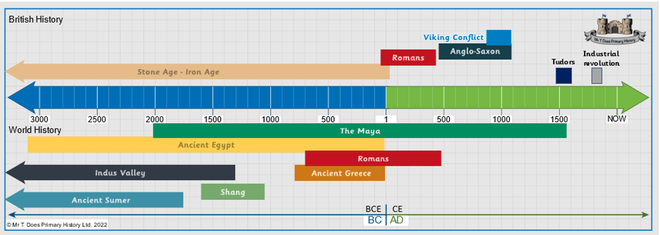
- Enable pupils to see history as a narrative which all fits together to form ‘the big picture’ and not just discrete episodes of time. We know that the knowledge children learn must be connected as this strengthens the schema of a concept in their mind.
- Enable pupils to see history as who we are and why we are the way we are
- Develop life-long learners who ask questions and challenge thinking
- Promote curiosity and a love of learning about the past, including learning about how our local area has changed and been affected by the past.
All pupils are required to study history at KS1 and KS2 and follow the national curriculum. By following the national curriculum we aim to equip pupils to ask perceptive questions, think critically, weigh evidence, sift arguments, and develop perspective and judgement. In order to ensure a broad curriculum offer for all pupils, a school’s history curriculum should ensure that: there is a breadth of historical periods studied; a range of places and societies studied as well as the connections between them; that people, groups and experiences are studied, ensuring that no groups are misrepresented across the curriculum and a range of historical fields of enquiry are taught, for example, political, social and economic history. At Amberley we also believe in ensuring our curriculum is personalised to our local area and there has been careful consideration of what is taught in our history curriculum and why it was selected. We ask ourselves ‘why that? Why now? How did it earn its place in our curriculum?’
We also want our curriculum to be diverse and reflect all of our learners – we often use Emily Style’s metaphor of the curriculum as the mirror and the window: the mirror signifying that pupils see themselves in our curriculum and the window representing our ambition to show all pupils the world beyond their immediate experience.
Pupils make progress in history through building their knowledge of the past (substantive knowledge), and of how historians study the past and create accounts (disciplinary knowledge). Deploying both substantive and disciplinary knowledge in combination is what gives pupils the capacity or skill to construct historical accounts – they are closely related as it is through disciplinary methods that pupils are able to construct substantive knowledge of the past. Teaching supports pupil progress by embedding frameworks of content and concepts that enable pupils to access future material. Abstract concepts are best learned through repeated exposures in different, meaningful contexts. The amount of progress that pupils make through the curriculum is dependent at each stage on the range and depth of their existing knowledge and how secure it is in their minds. This knowledge is what allows pupils to understand new material. Some knowledge is likely to be particularly important to future learning (generative knowledge). Pupils are likely to benefit when curriculum design, teaching, and assessment prioritise this knowledge.
At Amberley, the substantive concepts that we use are:
- artefacts; beliefs; conflict; culture and pastimes; food and farming; location; main events; settlements; society and travel and exploration.
The disciplinary concepts that we use are:
- investigate and interpret the past; understand chronology; communicate historically and build an overview of world history.
All of these concepts feature regularly throughout the study of history in a range of contexts so children become familiar with them across their time at Amberley. We understand that repeated encounters and meaningful examples make new information more familiar to pupils and therefore easier to learn. Pupils’ prior knowledge also makes new information and abstract ideas more meaningful and therefore easier to comprehend and learn. Knowledge is generative – it enables future learning.