Amberley Primary School
Writing
Writing
Curriculum Intention
At Amberley, it is our intention to provide pupils with a high-quality English education that will develop their ability to speak, read and write with fluency, creativity and confidence. Our curriculum aims to ensure that all pupils master the fundamentals of sentence construction, developing a secure understanding of how sentences are structured and how vocabulary choices shape meaning. Through explicit teaching and modelling and repeated practice, children learn to apply these skills independently.
Children across the school are provided with many opportunities to develop and apply their writing skills across the curriculum.We aim to develop a clear understanding of the writing process; we strive to develop pupils' understanding of audience and purpose, enabling them to make informed choices about language, tone and structure when writing for a range of purposes and contexts. We aim to nurture confident, innovative writers, who see themselves as authors, crafting meaningful pieces that inform, entertain, persuade and express their own thoughts and imagination. In order to establish this, pupils will develop their knowledge of genre features, language and composition.
Our English curriculum prioritises the explicit teaching of carefully selected vocabulary, enabling pupils to develop a rich understanding of word meanings, relationships between words and the nuances of language, including implied meaning and figurative language. Through explicit modelling of spelling strategies, including the exploration of etymology and morphology, pupils develop the knowledge and confidence to apply these strategies independently, strengthening both their written accuracy and their ability to make purposeful language choices.
Curriculum Implementation
At the beginning of each academic year, pupils revise and consolidate foundational knowledge of sentence construction, punctuation and grammar. Each half-term thereafter begins with a 'Sentence Building' (KS1) or 'Sentence Blast' (KS2) week, where children are able to consolidate and strengthen their understanding through activities that develop their ability to combine, manipulate, refine and accurately construct sentences. Revisiting such fundamental skills consolidates prior learning, addresses gaps in understanding and establishes a secure foundation for pupils to build upon as they progress through the writing curriculum.
By drawing on high-quality texts, we strive to equip our children with the tools and understanding they need to craft purposeful, engaging and effective writing of their own. The first stage of any unit is to assess children's prior knowledge through the completion of a 'cold write'. We then immerse children in a model text, encouraging a deeper understanding of the literary content, features and structures required in writing. During this immersive week, children will use a range of reading strategies and interactive activities to promote a secure knowledge and understanding of the text type.
The next phase of teaching is the innovation stage, where teachers model writing in collaboration with the children in their class to demonstrate the processes of writing. Throughout this explicit modelling, teachers demonstrate their ‘think-aloud’ process, making their thinking visible to pupils while modelling spelling strategies consistent with those taught in discrete spelling lessons, such as exploring word morphology and segmenting words into syllables. Oral rehearsal is used as a purposeful tool at this stage of writing to support accurate sentence construction, allowing pupils to practise, refine and articulate their ideas aloud before committing them to writing.
At the final stage of a unit, children plan their independent invented piece using the 'boxing up' method. This is used as a support tool when completing the assessed 'hot write' before evaluating the effectiveness of their writing by editing and re-drafting.
Book-Led Curriculum Approach to Writing
At Amberley, we understand the importance of instilling a love for reading within our pupils and recognise the significant impact this can have on a child's ability to produce accurate, imaginative writing. The English curriculum is taught by studying a range of high-quality texts or extracts, which cover a breadth of genres and, where appropriate and purposeful, provide strong cross-curricular links. Grammar, spelling and oracy are carefully woven throughout units of learning, with grammar objectives purposefully selected to complement the genre, audience and intended purpose of each writing outcome, ensuring pupils can apply their knowledge meaningfully and in context.
Mastery Approach to Writing
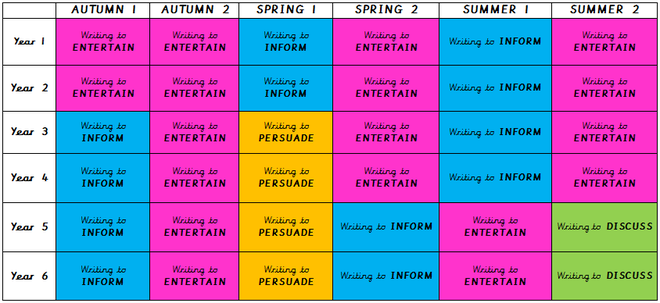
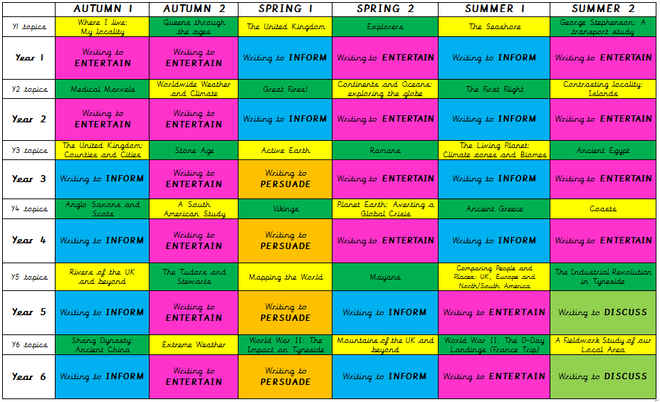
When planning our English curriculum, we have adopted a mastery approach to writing. Using this approach allows staff to build longer units of work, which focus on less elements of writing yet in more detail. Units of work are planned within a ‘purpose of writing’ in mind. The idea behind these ‘four purposes of writing’ is that rather than trying to teach children seven or more different ‘genres’ or ‘text types’ across the year it is better to focus on what those genres have in common and the purpose behind them. Thus, across school we have four main purposes of writing:
Amberley Mastery of Writing Long Term Plan
Amberley Mastery of Writing Medium Term Plan
Writing Curriculum Impact
Teaching and support staff use a wide range of formative assessment tools during the lesson to judge the impact that the teaching is having on children’s learning. At the end of a ‘hot write’, marking ladders are used to identify curriculum objectives which have been met through an independent piece of writing. Examples of children meeting these objectives are highlighted in blue within their piece of writing. Editing takes place after a hot write to address spelling, vocabulary, punctuation and grammar misconceptions which may have arisen. Children are given time to reflect on these and edit/improve their writing using a purple polishing pen. To give further support where needed, children are then grouped based on their needs and attend interventions based on the aspects of writing they have found challenging. It is vital that measuring the impact of our teaching of writing closely informs our planning going forward, individualising our curriculum to meet the needs of all children.
Promoting Handwriting at Amberley
At Amberley, handwriting is promoted across the curriculum, where staff have high expectations of pupils’ presentation. Recently, we have implemented ‘Nelson Handwriting’ across Y1-6 as a progressive teaching approach to promote the appropriate sizing and joining of letters, appropriate letter formation and to develop fluent writers. Pen licences are presented to children who show consistent and fluent cursive handwriting in their writing, as well as to those who show a great deal of effort in their written work. Letter formation is taught from the earliest opportunities and reinforced in phonics, English lessons and all written tasks.
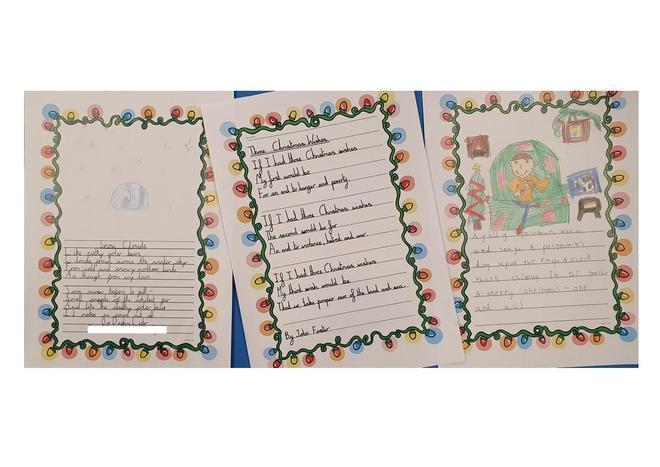
We further promote handwriting through termly handwriting competitions. In our most recent handwriting challenge, awards were presented for ‘most improved’ handwriting and ‘best overall’ within the year group. Here are some of our winning entries from the end of Autumn term 2022:
Please see our English documents and policies section for further information on our handwriting expectations and letter formation.